

Don't Let Spring Break Turn Into a Bone Break: Metatarsal Stress Fractures on the Rise in Gastonia

Transitioning from winter rest to spring exercise can put you at risk of a metatarsal stress fracture if you aren’t careful.
As the Gaston Greenway gets busier and local sports leagues kick off this March in Gastonia, we’re likely to see a sharp increase in a very specific, oftentimes “quiet" injury at Carolina Foot and Ankle Specialists: the metatarsal stress fracture.
Unlike a typical break that happens with a dramatic fall or a pop, a stress fracture is a progressive bone failure. It’s a hairline crack that develops from repetitive stress rather than a single trauma, and you may not even realize you’re dealing with a fracture until the pain makes it difficult or impossible to walk. By the time most patients schedule a visit with our Gastonia office, they’ve been pushing through a vague ache for weeks that’s gotten progressively worse, unknowingly turning a manageable injury into a significant fracture that, unfortunately, may require months of immobilization.
Muscle Damage to Bone Damage: How the Body Copes With Remodeling Lag
The cause of many stress fractures is the result of a complex biomechanical relationship. Your bones are living tissue that constantly undergoes a process called remodeling. Throughout the winter, when we tend to be less active, the bone-building cells (osteoblasts) slow down because the demand isn't there.
When you change your activity level and suddenly ramp up your walking or running mileage, your muscles fatigue quickly. Once your muscles are too tired to absorb the shock of the pavement or other impacts, that mechanical energy is transferred directly into the metatarsal bones. This is common when transitioning from winter to spring as Gastonia becomes more active during this period, but it can happen anytime of the year when activity levels suddenly increase after a period of rest.
There is a dangerous remodeling lag that takes your bones about 4 to 6 weeks to strengthen in response to new stress. If you increase your activity intensity too quickly during that window, the breakdown rate of the bone outpaces the build rate. The result is a stress reaction that, if ignored, results in a full stress fracture.

OTC pain medications only mask the pain of a stress fracture, potentially giving false confidence and making the injury worse.
The Problem with the Relying on OTC Pain Meds
We often see patients who have spent the first half of March trying to self-treat this pain with store-bought gel inserts or by simply taking more ibuprofen. Unfortunately, these treatments only mask the pain and may cause the problem to worsen more quickly.
Because a stress fracture is a structural bone failure, cushioning the foot doesn't solve the underlying instability. Furthermore, because anti-inflammatories only mask the pain, they may allow you to continue putting weight on a bone that is literally splintering. In our Gastonia office, we’ve seen cases where "waiting it out" resulted in a displaced fracture that eventually required surgical pins to reset, all because the patient didn't want to interrupt their spring break and thought they’d be able to push through it.
Differentiating Tendonitis from Bone Pain
It’s also important to note that there's a difference between bone pain and pain derived from tendonitis. The top of the foot is a crowded neighborhood of tendons, ligaments, and bones. Many patients mistake a stress fracture for extensor tendonitis. However, the treatments are opposite:
Tendonitis often benefits from gentle stretching and ice.
A stress fracture is aggravated by stretching. If you try to stretch out a stress fracture, you are effectively pulling on the bone segments, preventing the hairline crack from knitting back together.
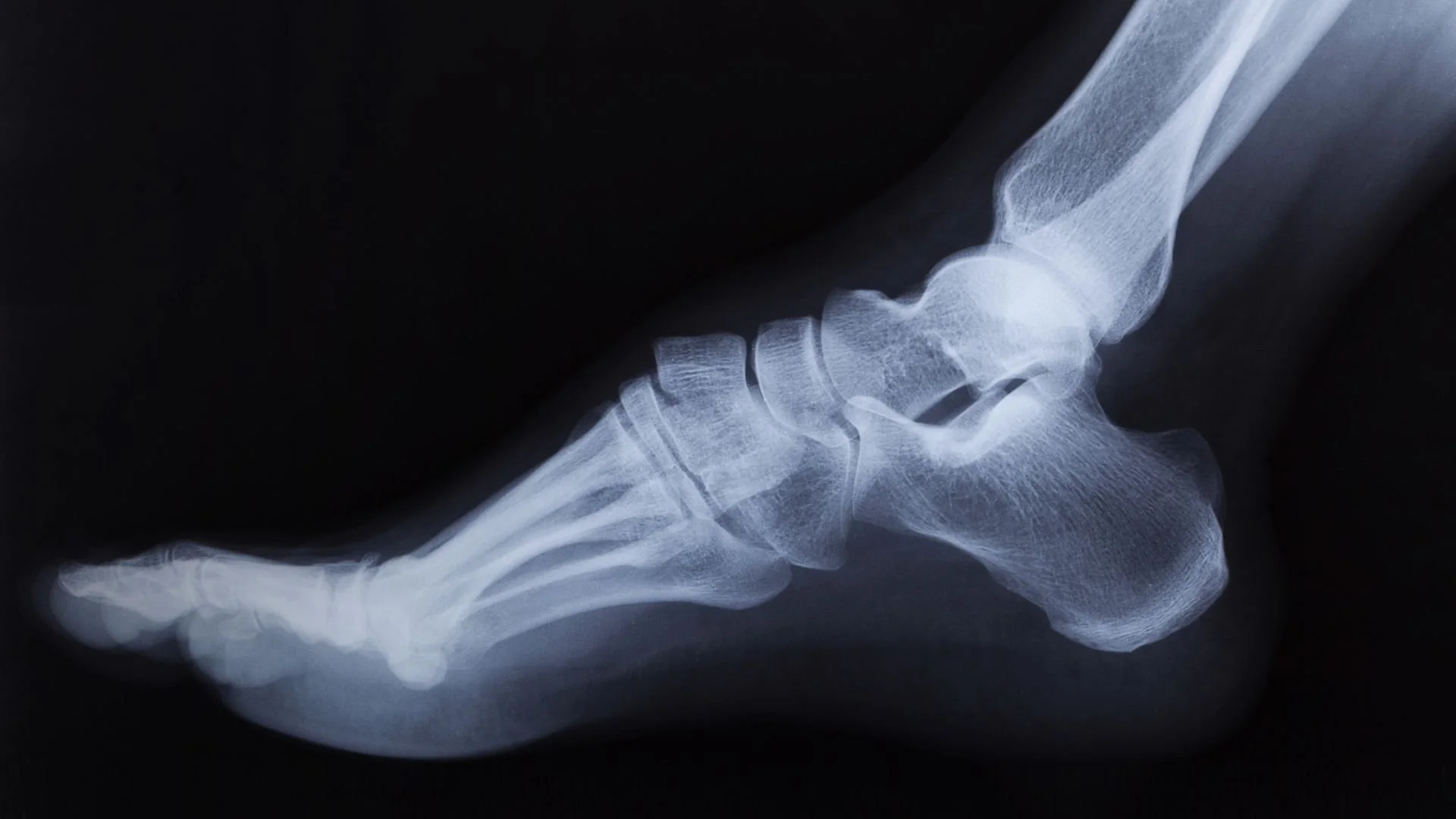
Imaging and focal point testing are two ways we can identify stress fractures in the metatarsal region.
Testing for Stress Fractures Using Imaging and the Focal Point Assessment
In our office, we use advanced imaging to look for the fluffy white cloud of a bone callus, which is the sign that your body is desperately trying to heal a crack. However, because early-stage stress fractures often don't show up on a standard X-ray for 2–3 weeks, we also rely on a clinical focal point test.
In a nutshell, if you can take one finger and press on an exact, pinpointed spot on the bone that makes you wince, that is a clinical sign of a stress reaction. If the pain is diffuse or spread out over the top of the foot, it is more likely soft tissue.
Schedule a Visit With Our Podiatrists at the First Sign of Trouble - Call CFAS Today!
If you are increasing your activity this month, be mindful of where you are walking. You can also take these steps to minimize your risk:
Vary your surfaces: If you’re used to a treadmill, don't move 100% of your miles to asphalt in one week.
The Squeeze Test: If you notice swelling on the top of your foot, stop your activity immediately. You may have significant edema if you can see veins on one foot but not the other.
A stress fracture doesn't have to end your spring, but ignoring it will. If the top of your foot is throbbing after your weekend hike, let's get a definitive image and a plan to keep the bone intact.